
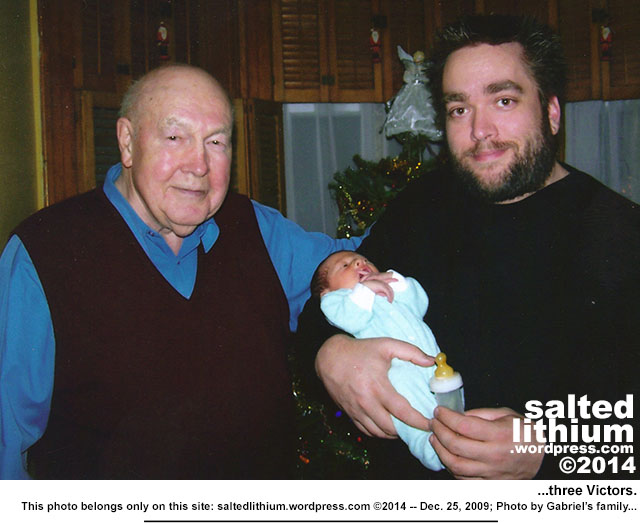

My grandfather died in August. At the end, it was not unexpected.
It gets that way when someone passes the 90-year mark, and he was 92-years old. I held his hand a few days before he stopped breathing. He was sitting in an uncomfortable chair, in a dark hospital room with three other dying men, beside a wide window with a view of a brick wall, and I knew it would be the last time. We talked about doctors, and tests, and my grandmother, and how much he wanted to go home. But he knew it wasn’t possible.
Almost every conversation we had over the summer, and even last spring, had a sense of inevitability in it… he wanted to be younger. To be free of the pain in is legs and back. To be able to walk without a walker. To be able to walk the fences on his hobby farm, to make sure they were secure so the cows couldn’t escape. He wanted to be able to talk without pausing for words. To hear without needing repetition.
He wanted to eat properly cooked food, to enjoy taste. Until recently we would meet at a local diner, for a lunchtime steak, with mushrooms and horseradish. That’s what he wanted.
To sit down with his friends over coffee and talk about engineering, to talk about recent news, to catch up on the Canadiens, to trash talk the Senators, to find out more about his grandchildren… to ask about his great-grandsons. To flirt with the waitress.
For the last few years he lived in a retirement home that he hated. A few years ago, there was a fire at the one he liked… the one where he was happy, and he had to move. He was hurt, physically, during the evacuation. And he never really recovered, mentally, from having to abandon his home. From having to run away from his belongings, from having to not be in charge of his life. My grandfather, until then, was someone who ran in to help. He was the one who was most likely ‘in charge’. But after that, I think, he felt smaller. He felt frailer. He felt like there was an ending coming. Like he could see he was losing, or lost, control over his life. And he hated it.
He had been a large man. A quiet, dignified man. A man people listened to, who went to for advice, someone we learned from. He grew up poor, with three sisters and three brothers… his father was a train conductor, his first home was a renovated blacksmiths shed. But he graduated from three of Canada’s top universities. He was a star athlete, he won a Memorial Cup playing for his University hockey team. Strong, vital, intelligent… and he knew, towards the end, exactly what his condition was. There was no dementia in the end. There was no short circuiting.
When he had the energy, he could still be engaging. But everyday there was less energy. Less willingness to talk. More pain in his eyes. More complaints about his joints. More complaints about doctors. About not having control over his life, about having to rely on people to change his fucking pants. About having to wear fucking diapers. About not being able to tell his stories anymore.
He tried, over the summer, to repeat his stories to me… to show his work photos to his 4-year old great-grandson, my son. And I listened. And my son played on the floor between us. I had heard them all before. Several times. And I laughed in the right places, but not because I had to. Because his stories, his life, had meaning. He had done things, met people, had insight worth listening to over and over again.
I never stopped him from telling me a story I had heard a dozen times over. Ever. Later on, I could help him. I could give him the right word to help him continue his story, but I’d always listen. I was always interested. Not because there was a duty, but because he had been around the world dozens of times — he had dinner with presidents of country’s, and university’s, but never talked about those. He never bragged about his accomplishments, or talked himself up. It was always about the work. It was always about the people he worked with.
He talked about his friends. About the people he worked with. About the people he trained and hired. He never talked about being captain of his hockey team, or being the leading scorer in his league every year he played. He talked about the game he was watching. He talked about the players on the ice.
He hired people who needed the work. Then he taught them the skills to keep them working. After church, when we visited him on his hobby farm in rural Quebec during the summer, he would take my brother and myself out for an ice cream. Or a pop. Then we would visit with his friends along the long, winding road back.
On his farm, I would quietly follow him, waiting to be needed to hold a flashlight, or just to be useful. He taught me to drive his tractor when I was 9-years old. He put me in charge of driving the pick-up truck. Of baling the hay. Of feeding the cows, we would walk through the fields — him wearing a handkerchief on his head, me wearing rubber boots that were just a little big, and he would tell me the names of all the cows. Even the ones in the freezer.
I never had a father. So he made sure that I understood life. And he did it quietly. In short, two-week clips.
A few years ago, he told me he understood how sick I had been. That he understood — between the manic depression, and my father abandoning us — how hard my life had been. He actually told me that, just quietly and without judgment or accusation… “I know you’ve had a hard life.”. And I nearly broke down. Not out of sentiment, but because I finally understood that he had been watching me.
Then, in the end, during his last few days in the hospital, my quiet grandfather started talking about love, and life, and hope. He had visits from friends, people he had golfed with for years, people he had worked with years ago, family. And he told me he loved me. That he loved my son, my family.
That he respected me. Then I held his hand. I gently shook it. And left.
My mother was in the room when he died. He was talking to her, decided he wanted to take a nap, and didn’t wake up.
Because there were so many people who wanted to be at his funeral, to pay their respects, the service was held a few weeks later, on September 6. The next day, we buried him in a small cemetery, close to his hobby farm, in the mountains of Quebec.
…my baby boy, my grandfathers third great-grandson, was borne later that night.
.

.






 01
01 06
06








 ...salted lithium.