I could stare at this photo for days. Maybe longer.
Last week my girlfriend and I got tired of being stuck in our little village. So, while her oldest son was with his father on their court-mandated visit, the two of us packed up Victor and headed for Ottawa for shawarma at Shawarma King on Bank Street.
It’s kind of our place. I introduced my girlfriend to the delights of a beef plate when we first started dating. Now she’s addicted to the garlic.
Before we got to the restaurant we walked up Bank Street to Parliament Hill. The four of us go for regular walks in our village, but there are only so many variations on ‘there and back again’ here. And we’ve pretty much done all of them twenty times over.
It was the first time she’d walked that far down / up Bank Street, which still seems weird to me. I lived in Ottawa for ten years before moving to Toronto, and then back here — with a few stops in between, so Bank Street between the Glebe and The Hill has been ‘the back of my hand’ familiar for most of my life.
There’s even a building on the corner of Bank and Something that my step-father (the architect) designed. So it was fun to play tour guide.
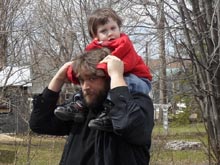
When we got to Parliament Hill we sat around the Centennial Flame — Victor managed to toss a few chicken McNuggets into the flame, which I thought was hilarious — and I took some photos of my girlfriend and our son sitting on the edge. Then she insisted on taking one of us, and this photo happened.
And I think it’s just… awesome.
I have a few other photos of the two of us, which my girlfriend also took, that I really like. Including one that I like almost as much as this one. But most of the shots of us are… not good. Either my gut’s in the way, or it looks like I haven’t washed in a week, or something’s just wrong.
But this one… that’s what the two of us look like all the time in my head.
When we were kids, and we were lucky, it would rain. And the parking area of my grandfather’s mountain farm would fill up with streams and rivulets. The farm house was in a small valley, near the top of one of the mountains in the chain. So, after a hard rain, the water would pour through from the forest above us.
We knew my grandfather built dams for a living. Maybe we didn’t know, at the time, it was a job. Maybe to an eight-year old it was just something he did. But never talked about. It was always other people who talked about the massive hydroelectric projects he worked on as an engineer.
But my little brother and I would go out after the rain had stopped, sometimes while it was still coming down, and make little dams in the little streams. Pretending to be our grandfather.
We would squat, like only children can, out in the yard molding the wet dirt and clay into six-inch high blockades that were quickly overrun by the water.
They always failed — water over the top of our dam, water around our dam… mostly they collapsed, but always they eventually turned into islands.
I don’t know why he did it, I know he almost immediately regretted doing it, but one afternoon my grandfather stopped and watched my brother and I creating islands in his yard.
I can’t remember what he said, but basically it sounded like “…no. You’re doing it wrong.”. And he bent over to pick up a stick before walking towards us.
“First,” he said, “you need to find a better place to start.”
And he brought us to a spot where several of the rivulets came together to form a larger stream.
“Then,” he said, “you’ll need a reservoir.”
And he used the stick to sketch out an area we needed to dig out.
“And,” he said, “you’ll need to reinforce the dam.”
And he taught us how to weave sticks together to use like steel reinforcement bars.
Then he left us, walking to his machine shed to continue working.
So we dug a reservoir, as deep as we could before hitting the bare mountain. Then we made it as wide and long as the length of my arm. And, as the rivulets filled the reservoir, we found sticks and wove them together. And we used clay instead of dirt, and built the dam up around the sticks.
But we didn’t stop there. We built the dam long and high. We extended the reservoir. We built smaller dams further out to channel the water from other rivulets to the reservoir. Once we knew how, everything just made sense.
When we were done we stood up and looked at our dam, and were so proud to have flooded out a third of my grandfather’s parking area.
And then we realized we had flooded a third of our grandfather’s parking area. So we drilled holes at the base of our dam to let the water out. And then we built channels around the dam, and the engorged reservoir gradually emptied.
And then we left, as children do, to find something else to do.
And our clay, stick reinforced dam dried into a concrete, stick reinforced foot-high wall.
For us the hardest part wasn’t being forced to take the dam apart with hammers and a shovel. The hardest part was never being able to build another one.
YouTube Alert: The driveway to his farm house, mostly we talk about the 20,000 trees we planted…
YouTube Alert: The road back, we stop so he can look at an epic engineering project…
My grandfather turned 90-years old just a few weeks ago. His health has been… poor since fire nearly destroyed the retirement home he was staying in. Two of his close friends died, but he and my grandmother made it out. Unfortunately he was injured in a way, a pinched nerve in his thigh, that makes it almost impossible to walk.
Something else went wrong on Friday afternoon, and he has been in the hospital ever since. It’ll be at least another three to four days until they let him out.
If that happens, if he can get out of the hospital. The painkillers, and the intestinal problems, are causing him to lightly hallucinate. He has lost his days. He’s convinced he’s been the hospital for days. That the nurses are conspiring against him. I think most of us are just waiting for something inevitable to happen.
Healthy people recover from what he has. But the chances get a lot slimmer when the patient is frail, and old, and breaking down.
There’s just a feeling that he might have gone as far as he can go.
I’m poor. Constantly broke. I’ve lived in poverty my entire life. I was raised, first by a political collective of people who believed poverty was a virtue and an ideal, and then by a single mother who had no support from her ex-husband or her family.
For years we survived on store credit. When I moved out I lived on social assistance for four years before taking on student debt to get through college, and then spent two years working for less than $14k/year.
I spent two years making $40k/60k, but was constantly broke before finally collapsing again into social assistance, under-the-counter labour and finally back on to social assistance and then on to a disability pension.
Poverty, long ago, had become a behaviour in my life. Like the motions associated with a two decade, two pack a day smoking addiction. Like a dog salivating at the sound of a bell. Poverty is something I’m programmed to be, something I’ve been programmed to live in.
As a behaviour, poverty is one of the most destructive ones in my life, and of those it predates the manic depression.
Actually, I think all of my self-destructive behaviours predate the manic depression, the onset of the bipolar just amplified them… and wouldn’t allow me to deal with them properly or in a healthy way — I had thought about suicide before the manic depression, but the manic depression gave me days and days of non-stop suicide fantasies.
How I was raised gave me a tutorial in how to be poor, but the manic depression prevented me from finding and keeping a job, or the training necessary to break the short cycle of idealized poverty in my family.
So how do you change behaviours, especially ones that lead to destructive ends, when those behaviours are all you know?
Turns out there are small scale experiments being performed on people with schizophrenia using gaming technology to change behaviours, and the results are, basically, just this side of miraculous.
That the brain is plastic, the idea that it can be reprogrammed, is not new. It’s called neuroplasticity:
…they glimpsed a revolutionary idea about the brain: the ability of mere thought to alter the physical structure and function of our gray matter. For what the transcranial-magnetic-stimulation (TMS) test… revealed was that the region of motor cortex that controls the piano-playing fingers also expanded in the brains of volunteers who imagined playing the music — just as it had in those who actually played it. [T]he discovery showed that mental training had the power to change the physical structure of the brain.
This isn’t new, the above quote was taken from a 2007 feature in Time Magazine. From what I’ve read some of the therapies I’ve used, and had success with in the past few years, like EMDR (eye movement desensitization and reprocessing), resemble the therapies being discussed in neuroplasticity.
What does seem to be new is the research has switched from three decades of looking at neuroplasticity as a way to recover from brain damage — sensory function, phantom limbs, chronic pain — and into mental illness, including the behaviours left from decades of untreated manic depression or schizophrenia.
This isn’t meditation. It’s not a replacement for medications or talk therapy. It’s an additional tool that’s coming online for us to use in our treatment. What it is, it seems to me, is a way to direct treatment specifically on the behaviours associated with the disease.
Activists in the anti-psychiatry movement were quick to adopt the idea that brains could be reprogrammed, but no one involved with neuroplasticity as a treatment for people with a mental illness has suggested it replace psychiatry.
I think what I’m saying is, over a long period of time, as poverty becomes a behaviour, it has the capablity to cause brain damage. My behaviour as an adult, whether I was on social assistance, or making $60k/year was no different than the behaviours I had as a teen when I was working summers as a farm hand for $3.50/hour.
At the end of the day, I was poor because, possibly, that’s how I was programmed.
For the first eight years of my life I lived in a political (communist) collective, where people tried to prove their loyalty to the group by making the most sacrifices. The individuals would go out, work in factories or wherever, and bring their paychecks back to the collective.
The money would go into a pool and be doled out according to need. One man took $0.08/week to satisfy his candy craving. Another took just enough for a few cigarettes. These were people working long and hard hours, bringing home decent wages, but giving it all up for the sake of poverty as an ideal.
Another behaviour is my inability to look after my health. Growing up, I was left to the care of the collective — one of the more bizarre tenets of Maoism is children should have no greater connection with an individual over the group. In other words, I had no parents, I had individuals assigned to take care of me on a daily or weekly basis.
Then toss in the added unique form of nihilism that comes from fourteen years of untreated manic depression — it’s not a disease that allows for healthy behaviours.
I think this is how my brain has become wired in a way that makes being poor and self-destructive… normal. But these are just two of several harmful behaviours I’ve adopted, or been taught, over my life.
It’s possible that I’m comparing apples to cats, but the behaviours that have plagued my life are very similar to those exhibited by the test subjects in the documentary I’ve embedded below… as are the needs that cannot be met without the added treatment, such as the need for steady employment, the need to take care of myself, the need to be healthy.
I’ve been (mostly) suicide-thought free for a few years, and that’s almost entirely due to the medications giving me the ever increasing time and space between depressive episodes I needed to understand the power of the disease comes solely from its weight as an anchor.
So, with treatment, I am healthy. But I’m still trapped by the remaining behaviours associated with the disease, and all of those years of being unable to deal properly with the behaviours associated with how I was raised.
…anyway, the documentary originally aired on “The Nature Of Things”, a weekly CBC program now in its 50th year. It features information and stuff originating from studies of things performed by people who know more about my brain than I do. Duhr.
Links:
1. The Brain that Changes Itself;
2. The Brain: How The Brain Rewires Itself;
3.Neuroplasticity (Wiki);
4. Impaired Neuroplasticity in Schizophrenia and the Neuro-regenerative Effects of Atypical Antipsychotics;
5. Neuroplasticity and Experimental Treatment Paradigms;
6. Neuroplasticity and psychiatry;
7. Antidepressants and neuroplasticity;
8. Neuroplasticity Studies Give Hope for Treatment Advances;
9. Brain-derived neurotrophic factor and neuroplasticity in bipolar disorder;
10. Eye movement desensitization and reprocessing (EMDR);
11. How I fight manic depression (mine).
For the past few days the thermometer has been pushing towards 40C (104F), which is stupid hot.
It’s starting to cool off tonight, and it’s supposed to get much nicer for the weekend, but it’s still +30C in my apartment.
So… all of the words that normally fill my thinking thing are gone. And I’m really, really tired. So here are some photos, some videos and a song or two.
Remember, if you’re taking Lithium, get your levels checked. Heat + Lithium = bad.
I don’t believe there’s an ‘afterlife’. I believe this is it, there is nothing after.
I do believe we are made of atoms. We are a collection of pieces that makes us each unique. Other than how they’re grouped together, there’s no difference between me, you, your pet.
Somehow we came together and, when we’re done, those pieces go back to wherever, where they become something else. Or tiny pieces of a million other things.
That’s what I believe is happening to my daughter right now, that she’s slowly becoming a tiny piece of a million different things.
I don’t believe in an afterlife, I don’t believe we’ll ever take this form again, but I don’t think we really ever die.
My daughter was, for a brief moment, a unique collection of atoms. And now she’s becoming pieces of something else.
The headstone is in the ground. As soon as the worker guy left the boys started planting daisies they ripped out of the ground from a nearby field.
…I guess that’s it. I’ll start sending out the photos tonight so, if you offered to help, you’ll be receiving one. I can’t afford to print and mail them, but they’ll all be a high enough quality that you can make anything from a 4×6 to a poster-sized enlargement that looks great.
…I screwed up the headline in the original version of this post. All three of my sisters are doing just fine.
Whoops, I screwed up the security settings on the videos… sorry about that. They’ll work now.
In its 100-year history the company constructing the headstone for our daughter has never, ever, had a request to have the family there when the stone is installed.
We’re the first, and they’ve been very confused about it. I think they believe we don’t trust them to do a proper job.
But it just seems like a logical piece of the process, at least to us.
The stone is bigger than we planned. They’ve added four inches horizontally, and at least two inches vertically, because when the stone sits in the ground they expect grass to grow over the edges.
The inscription reads:
Evangeline Rose
[last names]
April 6, 2012
A day can be forever.
I wanted to go with “Forever can be a day”, but no one else seems to like it like that.
The stone was supposed to be installed on Friday, but they rescheduled until Saturday morning, and now it won’t happen until Monday at 9am. Our plan is still to place a list of the names of people who donated towards the cost of the stone — which ended up being $1017. I’ve done the math to the best of my ability, and in total the donations were $650.
Which was way more than I thought people would send. I ended up covering the rest myself because there have been problems with my girlfriends Employment Insurance / maternity leave / health leave benefits.
Her second-to-last cheque is now two weeks late. Which means, in addition to covering the remaining cost of the stone, I’ve also been covering the cost of milk, food, diapers… life stuff — my girlfriend has an infected tooth, so I had to cover her dentist appointment, as well as her car insurance.
At this point I’ve spent most of my June rent on non-rent related stuff, so take that Mr. Landlord. The government people promise she’ll receive her cheque by next Thursday. She’s going back to work in July, which — for a while — means we’re back to a 5am – 6pm schedule.
In that, she’ll be leaving for work at 5am and won’t be home until 6pm. So, because her oldest is done school in ten days, I’ll be looking after both kids.
Which didn’t work the last time when it was just Victor and myself, I’m thinking that the addition of my girlfriend’s oldest son into the mix is not going to go well. Maybe for the first few days, maybe, but after that… probably not.
Maybe I’ll get lucky and have a stroke.
This is a quickie video my girlfriend made of me and our son at the park… I’m the one in the black T-shirt.
This is a few minutes of a thunder storm from a few days ago. There’s been lots of weird weather recently, including some tornadoes, and a few almost-twisters. This one dumped pea-sized hail for almost five minutes. Plus you get to see the view from my balcony.
"My mission in life is not merely to survive, but to thrive; and to do so with some passion, some compassion, some humor, and some style." ~Maya Angelou










 01
01 06
06








 ...salted lithium.